Redefining Teacher Training
Pakistan faces a “time-lag dilemma” (Jabeen, 2022) as by the time reforms reach classrooms, both global pedagogical trends and local needs have already shifted. This gap leaves teachers underprepared for the realities of modern learning environments. In such a context, teacher training cannot remain reactive or episodic; it must be forward-looking, agile, and designed to help educators thrive in rapidly evolving educational landscapes.
In 2020, Next-Gen Impact (NGI) Consulting embarked on a mission to better understand teachers’ professional development needs. We surveyed 2,000 school teachers, later extending the survey to 150 college teachers and 80 educators from the Middle East.
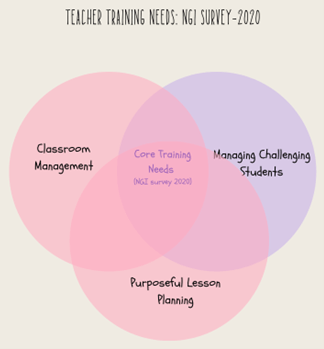
The findings revealed a significant overlap in training needs across these groups. Teachers consistently highlighted three priorities.
Creating purposeful lesson plans
Managing challenging students
Mastering classroom management techniques
These areas are critical for improving teaching effectiveness and ensuring that students receive high-quality education (NGI Consulting, 2020).
Education is not static. With rapid technological advancements and shifts in pedagogy, teachers’ demands continue to evolve. In 2023, recognizing the growing presence of artificial intelligence (AI) tools such as ChatGPT in classrooms, the NGI revisited its earlier study with minor adjustments. The updated findings confirmed our hypothesis that teachers’ professional development needs are changing.
Our updated NGI survey underscored a shift in perception: professional development is no longer viewed as a one-time event but as an ongoing journey. Educators expressed the need for ongoing support in three interconnected areas:
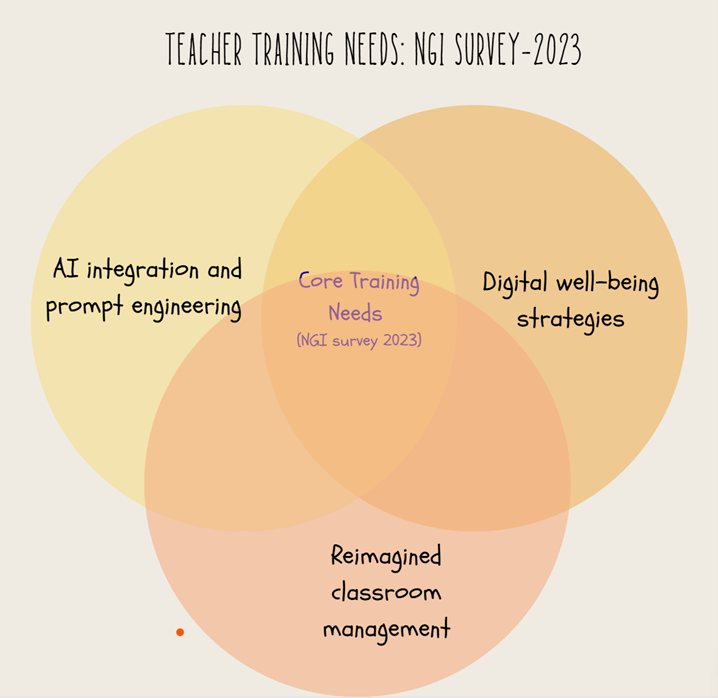
This aligns with scholarly insights that teacher growth must be adaptive, reflective, and context-driven, positioning educators as co-learners in a dynamic ecosystem (Darling-Hammond et al., 2017; Voogt and Pareja Roblin, 2021). This shift also reflects Jabeen’s finding that static, delayed approaches to teacher preparation widen the gap between what teachers need now and what training modules still offer.
While teachers had once expressed a strong desire for support in lesson planning, many now report greater confidence in using AI tools for this purpose than before. The challenge has shifted toward leveraging AI more effectively to ensure that AI-generated lesson plans remain relevant, personalized, and aligned with pedagogical rigor.
Recent research shows that AI can support differentiated instruction and formative assessment but cautions against “automation without intention.” Without strong pedagogical grounding, AI risks becoming a shortcut rather than a meaningful learning tool (Holmes et al., 2022).
Teachers also voiced concerns about rising screen dependency, especially after the pandemic. They requested guidance on the following:
These concerns are supported by global research showing that while AI can boost adaptive learning, unmoderated use may negatively impact attention spans and social-emotional development unless it is paired with intentional pedagogical strategies (OECD, 2023).
At NGI Consulting, we are committed to transforming these insights into actionable solutions. Our forthcoming blogs will share frameworks for prompt engineering for teachers and balancing AI with critical pedagogy. Our goal is to support educators not only in adapting to change but also in excelling as innovation.
The journey of modern education is one of continuous adaptation. To keep pace, Pakistan urgently needs a nationally coordinated, timely teacher-training program that:
Bridging the time-lag is essential. Training frameworks must evolve in real-time, aligning curriculum, pedagogy, and assessment with both local realities and emerging global trends. By integrating global research with local insights, Pakistan can create a teacher-training framework that is future-ready, contextually relevant, and scalable nationwide. This is not just about keeping up with change; it is about leading it.
The lesson is clear: Pakistan cannot afford to let its teachers fall behind while the world of education moves ahead. Bridging the time-lag requires a new mindset,one that treats teacher development as a continuous journey, not a one-off intervention.
At NGI Consulting, we believe the time has come for a nationally coordinated, future-ready training framework that equips teachers to lead change rather than chase it. The question is no longer whether to act, but how quickly we can align policy, practice, and professional growth to secure the future of our learners.
A beacon of excellence in the L&OD consultancy landscape. We bridge the gap between organizational objectives and outcomes through research-based interventions and “Data-Wisdom.”